AED
AED
For more than a decade, the UAE has been laying the physical and strategic groundwork for one of the most consequential infrastructure projects in its history. Etihad Rail, the country’s 900-kilometre national rail network, has already reshaped freight logistics. Now, with passenger services rolling out in phases through 2026 and into 2027, its impact is shifting from cargo yards to communities and nowhere is that shift more visible than in real estate.
For investors, developers, and homebuyers, the question is no longer if Etihad Rail will influence property markets, but where, how fast, and by how much.
A Network Built for More Than Freight
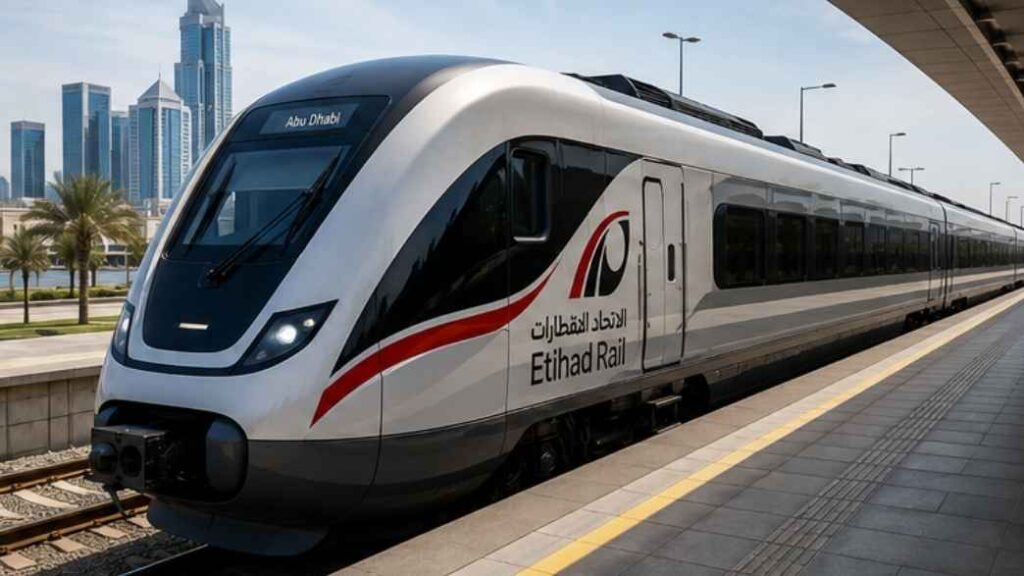
Etihad Rail began operations as a freight-focused system, moving goods across the Emirates and reducing reliance on heavy trucking. That freight backbone is now being extended into a full passenger network connecting 11 cities and regions, from Al Sila in the west to Fujairah in the east.
The rollout is happening in stages. An introductory phase between Abu Dhabi and Fujairah launched on 30 June 2026, cutting that journey to just one hour and 45 minutes. The network’s official launch follows on 30 September 2026, when Dubai and Al Dhaid join the line. Al Dhafra’s stations come online in December 2026, and the network reaches full completion with Sharjah’s station in March 2027. Once mature, Etihad Rail is expected to carry as many as 36.5 million passengers annually, with trains running at speeds of up to 200km/h.
This phased, multi-year rollout matters for real estate observers: it means the market impact won’t arrive all at once. Instead, it will ripple outward in waves, station by station, as each phase goes live.
Why Rail Lines Move Property Markets
The link between transit infrastructure and real estate value is well established globally. New stations tend to compress commute times, expand the radius of “livable” or “investable” locations around major employment hubs, and create new commercial anchors where none existed before. Tokyo, London, and Hong Kong all saw measurable property appreciation clustered around new rail stops in the years following their openings.
The UAE has its own precedent: Dubai Metro’s launch in 2009 triggered a wave of development and price appreciation along its corridor, turning previously overlooked areas into some of the city’s most sought-after addresses. Etihad Rail operates on a different scale connecting entire emirates rather than districts within a single city but the underlying mechanism is the same. Reduce the friction of distance, and previously marginal locations become viable.
Where the Impact Is Likely to Concentrate
Abu Dhabi: The Network’s Anchor
With the majority of the initial stations located in Abu Dhabi, including the centrally positioned Mohammed Bin Zayed City station, the emirate is positioned as the network’s operational core. Areas surrounding early-phase stations are likely to see the earliest interest from investors anticipating improved connectivity to both Dubai and the eastern coast.
Dubai: A New Western Gateway
Dubai’s first Etihad Rail station, opening in the network’s official September 2026 launch, is set at Jumeirah Golf Estates. Notably, future planning documents for Dubai’s rail network already anticipate this station linking into the city’s existing Red Line and the upcoming Gold Line by 2032 a signal that this location is intended to become a long-term multimodal hub rather than a standalone stop. Communities along this corridor stand to benefit from layered connectivity that few areas in the city currently offer.
Fujairah and the Eastern Coast
As one of the first two operational stations, Al Hilal in Fujairah gives the emirate something it has historically lacked: fast, direct access to Abu Dhabi in under two hours. For a coastal market long defined by its distance from the country’s major economic centers, this is a structural change. Tourism-linked and residential real estate in Fujairah may see renewed investor attention as accessibility improves.
Al Dhafra and Sharjah: The Later-Phase Opportunity
Stations in Al Dhafra (including Madinat Zayed, Mezairaa, and Al Mirfa) and Sharjah won’t open until December 2026 and March 2027 respectively. Markets here are likely to follow the classic “early-mover” pattern seen in other rail-driven real estate cycles: property values often begin moving before a station opens, as informed investors price in future connectivity ahead of the broader market.
Beyond Residential: The Commercial and Industrial Angle
Etihad Rail’s real estate story isn’t limited to homes and apartments. The network’s freight origins mean industrial and logistics real estate near rail-connected hubs is already seeing strategic interest from developers and free zone operators. As passenger and freight infrastructure mature together, areas with dual access to both networks may command a premium for warehousing, distribution, and light industrial use a less headline-grabbing but financially significant layer of the rail-driven real estate story.
Station areas themselves are also being designed with commercial intent. Reports indicate stations will include cafés, restaurants, and retail outlets, positioning them as small commercial nodes in their own right rather than simple transit points a model that tends to support ground-floor retail and F&B real estate in the immediate vicinity.
What This Means for Investors and Buyers
A few practical implications follow from the phased nature of this rollout:
Property near stations opening in the earliest phases (Abu Dhabi, Fujairah, and the September 2026 Dubai and Al Dhaid additions) is likely to see investor interest mature first, simply because connectivity becomes real sooner. Locations tied to later phases, particularly Al Dhafra and Sharjah, may still represent earlier-stage opportunities for investors comfortable with a longer horizon.
It’s also worth distinguishing genuine connectivity premiums from speculative marketing. Not every development “near” a future station will benefit equally — proximity, last-mile access, and a station’s integration into broader urban planning all matter more than simple distance on a map. The Jumeirah Golf Estates station’s planned integration with Dubai’s Metro network, for instance, is a stronger long-term signal than connectivity alone.
A Market Still Being Written
Etihad Rail’s full passenger network won’t be complete until March 2027, and a feasibility study is already underway to evaluate further expansion to additional emirates. That means the real estate story connected to this project is still in its early chapters. The communities, commercial zones, and investment patterns that will eventually be associated with “living near the rail line” are only beginning to take shape.
For real estate investors and homebuyers in the UAE, that’s precisely what makes this moment worth watching closely not because the transformation has already happened, but because it’s happening now.