AED
AED
If you’ve spent any time researching real estate investing, you’ve probably come across the term “Grade AAA” (or “Class A”) commercial property. It sounds prestigious — and it is — but what does it actually mean for your portfolio, and is it the right entry point for a beginner? This guide breaks down everything you need to know before putting your first dollar into premium commercial real estate.
What Does “Grade AAA” Actually Mean?
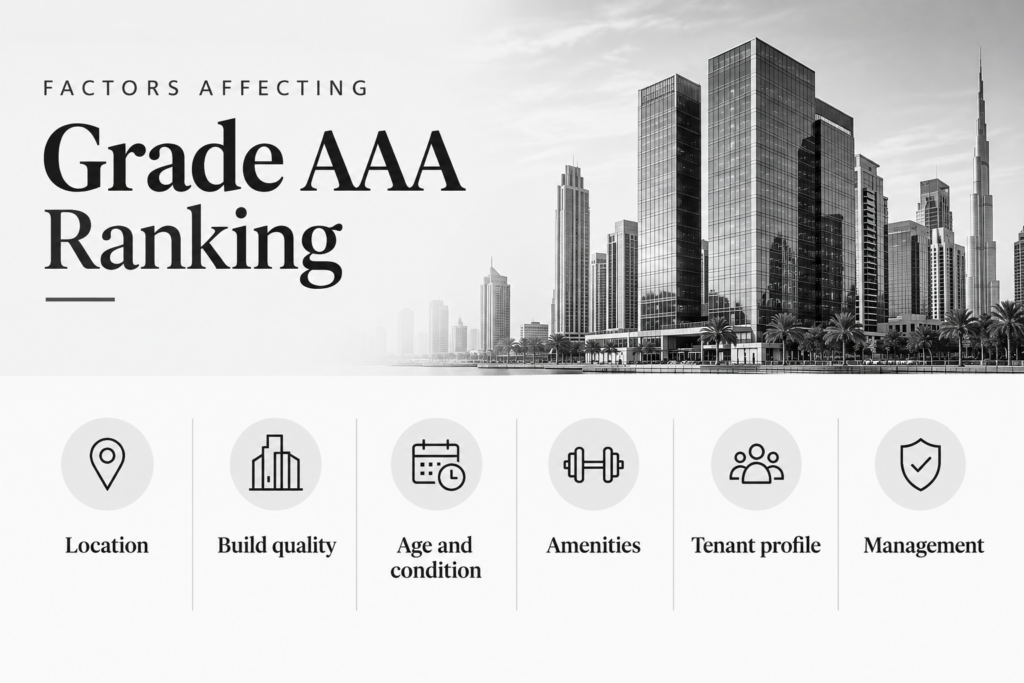
Grade AAA is the highest tier in the classification system used to rank commercial real estate — Class A (or AAA), Class B, and Class C — based on a combination of factors:
- Location: Prime addresses in central business districts or high-demand corridors
- Build quality: Modern construction, high-end finishes, and structural integrity
- Age and condition: Newer buildings or recently renovated properties
- Amenities: On-site facilities like fitness centers, conference spaces, high-speed connectivity, and parking
- Tenant profile: Occupied by reputable, financially stable corporations or brands
- Management: Professionally managed with strong maintenance standards
Grade AAA properties sit at the very top of this hierarchy. Think flagship office towers occupied by multinational corporations, luxury retail spaces on prime high streets, or state-of-the-art logistics hubs leased to blue-chip tenants.
If you want to go deeper on how these tiers play out in a specific market, our post on Understanding Grade A vs Grade B Office Space in Dubai breaks down the practical differences investors and tenants encounter locally.
Why Investors Are Drawn to AAA-Grade Assets
1. Stability and Lower Risk
Because AAA properties attract financially strong tenants who sign long-term leases, vacancy risk is generally lower than with lower-grade buildings. Big corporations rarely default on rent, and they tend to renew leases to avoid the disruption of relocating.
2. Predictable Income Streams
Long lease terms (often 5-15 years for office and industrial assets) mean investors can forecast cash flow with more confidence than shorter, more volatile leases common in lower-tier properties.
3. Resilience During Downturns
While no asset class is immune to economic cycles, Grade AAA properties tend to hold their value better during downturns. Tenants consolidating operations often move into premium buildings rather than out of them, seeking efficiency and prestige even when cutting costs elsewhere.
4. Appreciation Potential
Prime real estate in supply-constrained locations tends to appreciate over the long term, since new AAA-grade developments are expensive and slow to build, keeping supply limited relative to demand.
5. Prestige and Liquidity
AAA assets are highly sought after by institutional investors (pension funds, REITs, sovereign wealth funds), which generally makes them easier to sell when the time comes, compared to niche or lower-grade properties.
The Trade-Offs Beginners Should Understand
Grade AAA real estate isn’t without downsides, especially for a first-time investor:
- High entry cost: Premium properties command premium prices. Direct ownership of a AAA office tower or retail flagship is typically out of reach for individual investors without significant capital.
- Lower yields relative to price: Because these assets are considered safer, they often trade at lower capitalization (cap) rates — meaning your rental income as a percentage of purchase price may be lower than riskier Class B or C properties.
- Market sensitivity: Prime markets can still be cyclical. Office space, in particular, has faced structural headwinds from remote and hybrid work trends in many major cities.
- Illiquidity of direct ownership: Even though AAA assets are more liquid than lower-grade ones, direct property is still far less liquid than stocks or bonds — selling a building can take months.

Ways to Invest in Grade AAA Commercial Real Estate
You don’t need tens of millions of dollars to gain exposure. Here are the main routes:
1. Real Estate Investment Trusts (REITs)
Publicly traded REITs let you buy shares in companies that own portfolios of premium commercial properties. This is the most accessible option for beginners — you get liquidity (shares trade daily), diversification, and professional management, without needing to manage a building yourself.
2. Private Real Estate Funds
Some funds pool capital from accredited or institutional investors to acquire AAA-grade assets directly. These typically require higher minimum investments and longer lock-up periods but can offer higher potential returns than public REITs.
3. Real Estate Crowdfunding Platforms
A growing number of platforms allow smaller investors to buy fractional stakes in specific commercial properties, including premium-grade assets, with lower minimums than traditional private funds.
4. Direct Ownership (Syndications or Partnerships)
Joining a syndicate of investors to co-own a specific AAA property is another route, though it usually requires a larger check size and a higher risk tolerance, since you’re tied to one specific asset rather than a diversified portfolio.
5. Commercial Mortgage-Backed Securities (CMBS)
For investors who want debt exposure rather than equity, CMBS let you invest in bonds backed by pools of commercial mortgages, some of which are secured against AAA-grade properties.
Key Metrics to Understand Before You Invest
- Cap Rate: Net operating income divided by property value — a quick gauge of expected return relative to price.
- Occupancy Rate: How much of the building’s leasable space is currently rented.
- Weighted Average Lease Term (WALT): The average remaining time on tenant leases, weighted by size — longer WALTs generally mean more income stability.
- Loan-to-Value (LTV): How much of the property purchase is financed with debt versus equity — higher leverage means higher risk and higher potential return.
- Tenant Credit Quality: The financial strength of the companies leasing the space, since your income depends on their ability to pay rent.
Practical Steps for a Beginner
- Start with education: Understand real estate cycles, interest rate sensitivity, and how commercial leases differ from residential ones.
- Choose your access point: Decide whether a REIT, fund, or crowdfunding platform fits your capital and risk tolerance best.
- Diversify by sector: AAA-grade real estate spans office, retail, industrial, and increasingly data centers, each has different demand drivers.
- Diversify by geography: Prime real estate performance can vary significantly between cities and countries, so don’t concentrate your exposure in a single market.
- Review the sponsor or manager track record: If investing through a fund or syndication, research the manager’s experience and past performance closely.
- Understand the fee structure: Private funds and syndications often charge management and performance fees that can meaningfully affect net returns.
- Think long-term: Commercial real estate, even at the top tier, is generally a multi-year holding — it’s not designed for short-term trading.
Final Thoughts
Grade AAA commercial real estate offers a compelling mix of stability, prestige, and long-term value, qualities that make it attractive to conservative, income-focused investors. But “premium” doesn’t mean “risk-free,” and the lower yields and high entry costs mean it’s worth carefully weighing against your overall financial goals and risk appetite. For most beginners, starting through a REIT or diversified fund is a more practical way to gain exposure than attempting direct ownership from day one.
As with any investment, this article is for informational purposes only and isn’t personalized financial advice. It’s worth speaking with a licensed financial advisor to determine whether Grade AAA commercial real estate fits your specific circumstances and goals.
Vetra Real Estate helps investors identify, evaluate, and access premium commercial property opportunities with confidence. Our team specializes in sourcing Grade A and Grade AAA assets, guiding clients through every stage of the investment process from market research and due diligence to acquisition and portfolio management. Whether you’re taking your first step into commercial real estate or expanding an existing portfolio, Vetra combines local market expertise with a hands-on, transparent approach to help you make informed, long-term investment decisions.