AED
AED
There’s a moment in every real estate cycle when a market stops looking like an opportunity and starts looking like a foundation. Dubai’s luxury segment has reached that moment. After several years of headline-grabbing growth, the smart money isn’t retreating to lock in gains, it’s leaning in further. Understanding why requires looking past the glossy skyline renders and into the mechanics of capital, policy, and scarcity that are actually driving decisions in boardrooms and family offices right now.
The Numbers Behind the Confidence
Dubai’s residential market closed 2025 with nearly 200,000 transactions worth nearly $146.5 billion, marking roughly 19% growth in volume and 27% growth in value year-over-year. That kind of expansion would be remarkable on its own, but the momentum has carried straight into 2026. The first quarter of the year saw transaction values climb more than 30% year-on-year to over AED 250 billion, with the luxury segment specifically posting a 26% surge in value.
What makes these figures meaningful isn’t just their size it’s what’s underneath them. Analysts increasingly describe this as a market shifting from volume-driven speculation to value-driven maturity, where transaction growth is increasingly concentrated in higher-value, higher-conviction purchases rather than a flood of entry-level flipping. That’s a very different signal than the frothy pre-corrections that have burned luxury investors in other global cities.
Scarcity at the Top Is Doing Real Work
Dubai has plenty of new mid-market apartment supply on the horizon, but the ultra-luxury tier is a different story entirely. Developments priced above roughly $5.4 million require rare land parcels, established developer track records, and long construction timelines all of which naturally throttle how much new inventory can hit the market in any given cycle.
This structural bottleneck is precisely why prime addresses keep outperforming. Areas like Palm Jumeirah, Emirates Hills, Jumeirah Bay Island, and the emerging Palm Jebel Ali continue to see appreciation because there simply isn’t enough comparable product being built to meet demand. Even as the broader market moderates into a more balanced phase, ultra-prime real estate is behaving like a genuinely scarce asset class, the kind that tends to hold value across cycles rather than swing with them.
A Yield Story That’s Hard to Match Elsewhere
Luxury real estate in most global capitals forces investors to choose between capital appreciation and income. London, Monaco, and Singapore offer prestige and long-term stability, but rental yields in those markets are notoriously thin once you account for high entry prices, taxes, and ownership costs.
Dubai breaks that trade-off. Average rental yields are running between roughly 6-8% for apartments and 5-7% for villas, and because there’s no income tax, no capital gains tax, and no annual property tax, those yields translate almost entirely into investor returns. Combined with genuine price appreciation 2025 alone saw roughly 6.7% year-over-year growth described by analysts as sustainable rather than speculative, Dubai is offering a combination that’s genuinely rare in global luxury markets: you don’t have to sacrifice income for growth, or vice versa.
The Golden Visa Changed the Calculus
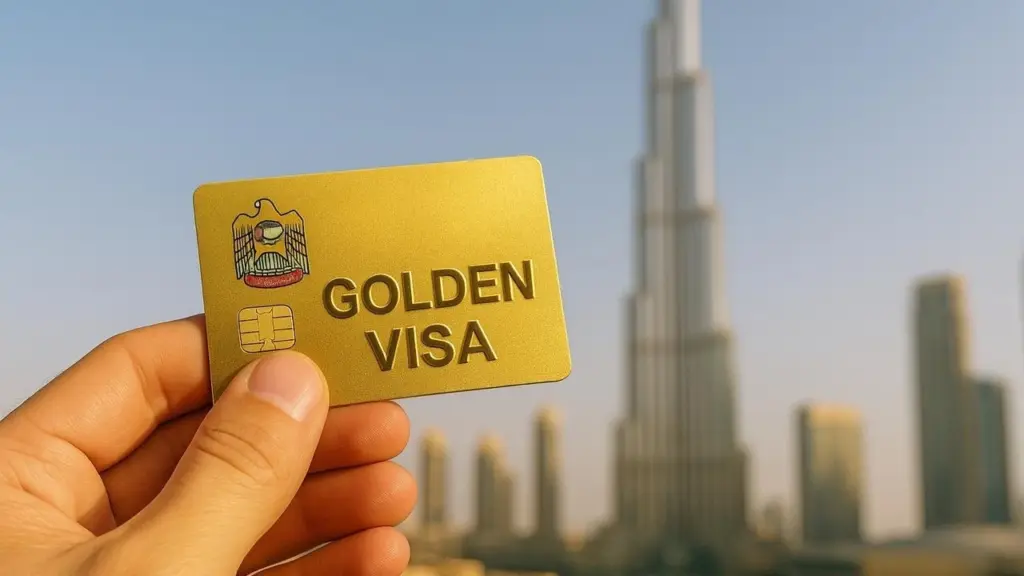
Policy has done as much as pricing to pull in serious capital. Dubai’s Golden Visa program grants ten-year residency to anyone investing at least $545,000 (AED 2 million) in real estate, extending to immediate family and requiring no minimum physical presence. For luxury buyers spending well beyond that threshold, it’s less a headline benefit and more a baseline expectation but its effect on market behavior is significant.
Because the visa rewards long-term commitment, it creates what analysts have started calling a “price floor”: investors anchored to a decade-long residency plan are structurally less likely to panic-sell during short-term volatility, whether that’s a regional geopolitical flare-up or a temporary dip in sentiment. That stickiness is exactly what institutional and family-office capital looks for before committing at scale.
Currency Stability in an Unstable World
The UAE dirham’s peg to the US dollar at 3.67 gives dollar-based investors something increasingly precious: the ability to plan without currency risk. For buyers in the US, parts of the Gulf, and anywhere else effectively pegged or dollar-denominated, that eliminates an entire layer of uncertainty that complicates real estate decisions in markets with floating currencies. European and British buyers get a similar benefit straightforward planning without the exchange-rate volatility that can quietly erode returns in emerging markets.
Flight to Quality, Not Flight to Risk
One of the more telling shifts in 2026 has been where capital is actually flowing within Dubai’s luxury tier. Rather than chasing whatever is newest or cheapest, investors are increasingly gravitating toward branded residences properties developed in partnership with recognizable global names and projects from established, credentialed developers. This “flight to quality” reflects a market that has grown more sophisticated: luxury buyers today are benchmarking Dubai against London, New York, and Singapore with real fluency, and they’re rewarding governance, delivery track record, and brand equity over marketing hype.
That sophistication cuts both ways. It means the era of easy, undifferentiated gains where almost anything purchased in 2021-2023 appreciated regardless of quality is genuinely behind us. What’s replaced it is a more discerning market where the right asset in the right location continues to outperform, while secondary product in oversupplied segments risks flatter performance. For informed investors, that’s not a warning sign it’s an invitation to be selective in a way the market didn’t previously require.
Resilience Through Regional Uncertainty
It would be incomplete to talk about 2026 without acknowledging the geopolitical backdrop. Regional tensions involving Iran and broader Middle East uncertainty have persisted through the year, and yet Dubai Land Department data shows transaction volumes accelerating rather than retreating during these periods. That resilience is increasingly being read not as luck, but as evidence of Dubai’s positioning as a genuine capital sanctuary, a place where institutional confidence, escrow protections for off-plan buyers, professionalized brokerage licensing, and a stable rule-of-law environment outweigh regional noise for global high-net-worth individuals moving wealth across borders.
Diversification of the Buyer Base Itself
Perhaps the most underappreciated trend is who is buying. International investors contributed well over AED 140 billion in early 2026 activity, drawn from more than 99 nationalities, while participation from women investors and first-time market entrants has grown meaningfully as well. A market this geographically and demographically diversified is inherently more stable than one dependent on a handful of buyer segments, it means demand isn’t hostage to any single economy’s fortunes or any single investor class’s sentiment shifting at once.
What This Means for an Investor Weighing Entry Now
The froth-driven urgency of 2023-2025 has genuinely cooled, and that’s arguably good news for anyone entering today. Buyers now have more room for due diligence, more negotiating leverage, and more time to be selective about location, developer, and asset quality conditions that favor considered, long-term positioning over momentum chasing.
The fundamentals that matter most constrained ultra-prime supply, tax-free income and appreciation, a visa program that rewards commitment, currency stability, and a maturing, increasingly institutional buyer base haven’t just held up. They’ve strengthened. That combination is precisely why investors aren’t cashing out after the boom years; they’re treating this moment as the more rational entry point the earlier frenzy never allowed.