AED
AED
The skyline above Dubai has always been a statement of ambition. Now, that ambition is literally taking flight not just in glass towers and architectural icons, but in the quiet hum of drones weaving between them. As the UAE accelerates its push toward autonomous urban infrastructure, drone delivery is emerging as a powerful force that doesn’t merely serve Dubai’s real estate sector it actively transforms it.
From luxury residential communities in Sobha Hartland to the high-rises of Dubai Marina, aerial logistics is rapidly becoming a differentiator that developers, investors, and tenants can no longer afford to ignore.
Dubai’s Drone Vision
The scale of Dubai’s ambitions here is striking. The Dubai Civil Aviation Authority (DCAA) has set a target of 30% drone delivery coverage across the emirate by 2026, with a goal of reaching 70% within the next five years. Phase one of the initiative has already launched in Dubai Silicon Oasis, with Phase two expanding coverage to a broader slice of the city.
This isn’t an experiment on the fringes. It’s city-level infrastructure being built with a clear mandate and real estate sits squarely at the intersection of where this infrastructure lands.
Drone-Ready Communities
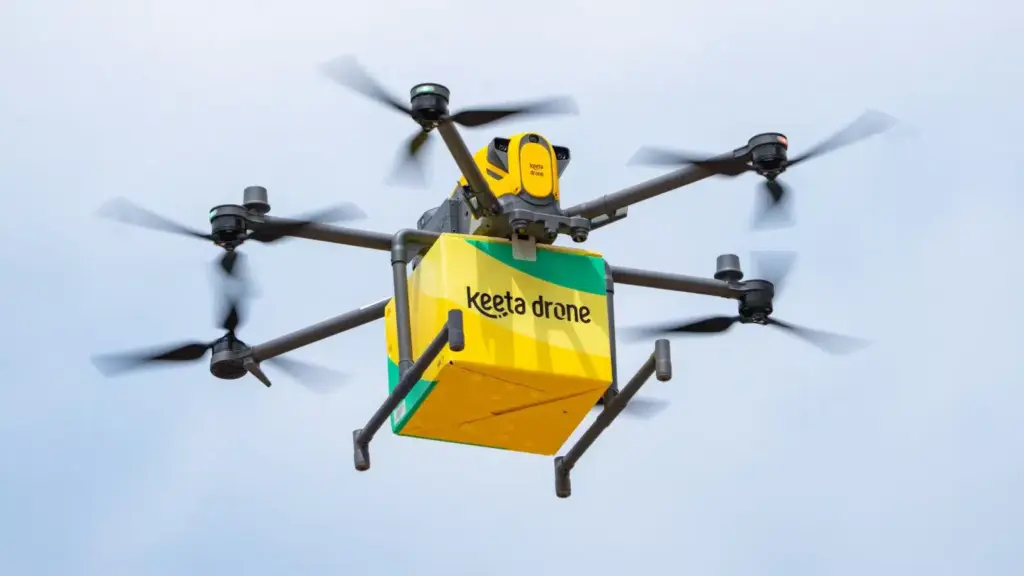
Perhaps the most immediate impact on real estate is the emergence of what developers are calling “drone-ready communities” residential and mixed-use developments that integrate aerial delivery infrastructure into their design from the ground up.
In a landmark move, Sobha Realty signed a partnership with Keeta Drone, the international arm of Chinese tech giant Meituan, and holder of Dubai’s first Beyond Visual Line of Sight (BVLOS) commercial drone delivery licence to introduce drone delivery services across its communities in 2026 and beyond. The collaboration is focused on supporting communities designed around quality, precision, and long-term thinking, with the stated aim of helping to shape what future urban living could look like.
Meanwhile, Emaar Properties has partnered with autonomous delivery providers to install smart locker systems in 47 residential towers, enabling drone and autonomous vehicle deliveries with an 88% successful handoff rate without human intervention.
These aren’t amenities in the traditional sense they are infrastructure upgrades that fundamentally change a property’s value proposition.
Boosting Property Values and Tenant Appeal
For developers, drone delivery capability is fast becoming a competitive advantage that influences buying and leasing decisions. Here’s why:
Lifestyle Enhancement as a Core Offering. Today’s Dubai tenant particularly in the premium segment is drawn to developments that offer seamless, friction-free living. Access to 8-minute drone-delivered meals, pharmacy orders, and parcels is no longer a novelty; it’s a lifestyle expectation beginning to take shape. Communities that enable this are positioning themselves ahead of the curve.
The ‘Smart Community’ Premium. Properties embedded in Dubai’s broader smart city infrastructure connected to drone corridors, autonomous ground vehicles, and AI-driven logistics carry a meaningfully different value proposition than those that are not. As drone coverage expands toward 70% of the city, being outside that coverage area will increasingly feel like a disadvantage, much like being off a metro line.
Attracting a Tech-Forward Tenant Base. Dubai’s rapid expansion as a global business hub has brought a growing cohort of high-net-worth individuals, digital nomads, and tech-sector professionals who view smart infrastructure as a baseline expectation. Drone delivery integration is a signal that a development has been designed for the future and that signal resonates strongly with this demographic.
Solving the High-Rise Last-Mile Problem
Dubai presents a unique logistical challenge: the city has over 900 buildings taller than 150 metres. Traditional last-mile delivery in this environment is slow, labour-intensive, and prone to failure. Drones offer a compelling solution.
Some buildings are now equipped with rooftop drone landing pads linked to automated package transport systems using service elevators, reducing delivery time to under four minutes. The implementation cost estimated at AED 180,000 to 250,000 per building is substantial, but represents a one-time infrastructure investment that future-proofs the asset and commands higher rents over time.
For developers, this is a meaningful shift: the cost of drone integration is being absorbed at the building level rather than passed through logistics fees, creating a durable amenity that adds lasting value.
Dubai Municipality and the Infrastructure Backbone
Drone delivery doesn’t happen in a vacuum it requires city-wide coordination, and Dubai Municipality is actively stepping up to provide it. Under a Memorandum of Understanding signed with Keeta Drone, the Municipality has committed to identifying and supporting suitable locations for drone operations, while Keeta Drone designs aerial routes and conducts technical and safety assessments.
This government-level backing is critical for real estate. It means developers can invest in drone-ready infrastructure with confidence that the regulatory and spatial framework will be in place. The UAE’s Unified Airspace Management System already coordinates all drone flights in real-time, creating structured aerial highways designated routes with set altitudes, speeds, and entry-exit protocols that make integration predictable and scalable.
For institutional real estate investors, regulatory clarity is everything. Dubai is providing it.
Master-Planned Communities
The ripple effects of drone delivery are beginning to influence how master-planned communities are conceived, not just built. When logistics can arrive by air, the spatial assumptions that underpin urban planning shift:
- Reduced ground-level traffic and parking pressure, as delivery vehicles make fewer trips into residential zones
- Quieter, cleaner ground-floor environments, since drone drop-off points can be elevated or centralised rather than clogging building entrances
- New design language for rooftops and podiums, as landing infrastructure becomes an aesthetic and functional consideration at the planning stage
- Lower carbon footprint, supporting Dubai’s sustainability targets and ESG-aligned development mandates
Communities being planned today are already incorporating these considerations, setting a precedent for how drone logistics reshapes the built environment from inception.
What It Means for Real Estate Stakeholders
For Developers: Early movers who integrate drone-ready infrastructure establish a competitive advantage that takes years for others to replicate. The Sobha-Keeta partnership is a template others will follow. The question is not whether to integrate, but when.
For Investors: Residential assets in communities with smart logistics infrastructure particularly those within the DCAA’s expanding drone coverage corridors are likely to command rental premiums and lower vacancy rates as the market matures. Proximity to drone corridors may become as meaningful a pricing variable as proximity to the Metro.
For Tenants: The practical benefits are immediate. Faster deliveries, reduced reliance on cars for errands, and the convenience of living in a genuinely connected community all translate to real improvements in daily quality of life.
For Commercial Real Estate: Drone logistics also has implications for retail, hospitality, and healthcare properties. Medical facilities that can receive drone-delivered supplies, hotels that can offer aerial concierge services, and mixed-use developments that integrate drone hubs as commercial amenities are all part of the emerging landscape.
Looking Ahead
Dubai’s drone delivery ecosystem is moving fast from controlled pilots to commercially integrated communities in the span of a few years. With plans to integrate drones into a significant portion of the city’s logistics network by 2030, the technology is shifting from novelty to necessity.
For real estate, this is a generational opportunity. The developers and investors who recognise drone delivery not as a logistics story but as a real estate story one about value, lifestyle, infrastructure, and urban design will be the ones best positioned to benefit as Dubai’s skies become a new axis of competition.
The hum overhead isn’t background noise. It’s the sound of property values being built.