
 AED
AED
$ USD
€ EUR
£ GBP
AED
Work, Live, and Grow — All in One Place.
Dubai Investments Park, universally known as DIP, is Dubai’s clearest attempt at a genuine city within a city: a 2,300-hectare master development established in 1997 by Dubai Investments PJSC that deliberately combines industrial, commercial, and residential zones within a single, self-contained community. Sitting at the intersection of Sheikh Mohammed Bin Zayed Road (E311) and the Jebel Ali–Al Habab Road (D57) near Jebel Ali, DIP hosts more than 4,200 companies and over 100,000 workers, giving its residential districts a genuinely stable, employment-anchored tenant base few other Dubai communities can match.
The community is structurally divided into DIP 1 and DIP 2, plus the newer DIP Third phase, and residentially organised into seven distinct sub-communities: The Green Community, The Palisades, Ritaj, Dunes Village, Dubai Lagoon, Ewan Residences, and staff accommodation. The Green Community remains DIP’s most established and upscale address, a gated enclave of landscaped gardens, lakes, and traffic-free streets built up over more than a decade, while Ritaj and Dunes Village offer considerably more accessible apartment pricing for professionals and families working within the wider industrial and commercial zones.
DIP’s own dedicated metro station, Dubai Investment Park Station on the Route 2020 Red Line extension, gives the community rail connectivity to Expo City, Jebel Ali, and central Dubai, a genuine advantage over many comparably priced communities further from the Red Line network. Schools, hospitals, hotels, supermarkets, and mosques all operate within the community’s gates, reflecting DIP’s original design intent: a place where daily errands rarely require leaving the neighbourhood.
For buyers, DIP’s investment case is genuinely compelling: 2025 data shows DIP villa prices recording the sharpest per-square-foot growth of any Dubai community, alongside apartment yields of 9% to 10%, among the strongest affordable returns anywhere in the city. Ownership structures vary meaningfully across the community, however, Green Community properties are predominantly leasehold, while other zones within the wider DIP corridor offer full freehold title, and buyers should always confirm tenure on a specific property before proceeding.
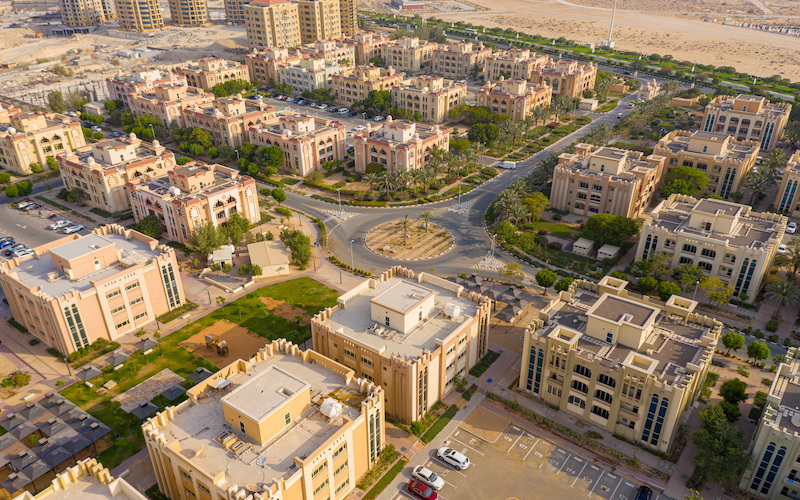
DIP sits at the intersection of Sheikh Mohammed Bin Zayed Road (E311) and the Jebel Ali–Al Habab Road (D57), giving residents direct highway access to both Abu Dhabi and central Dubai. The community’s position near Jebel Ali Port, Expo City, and Al Maktoum International Airport places it firmly within Dubai’s fast-growing western economic corridor.
DIP was explicitly designed around self-sufficiency, and that intent is genuinely visible in daily life: six schools, four hotels, two malls, supermarkets, and mosques all operate within the community, meaning most day-to-day errands can be handled without leaving DIP’s boundaries.
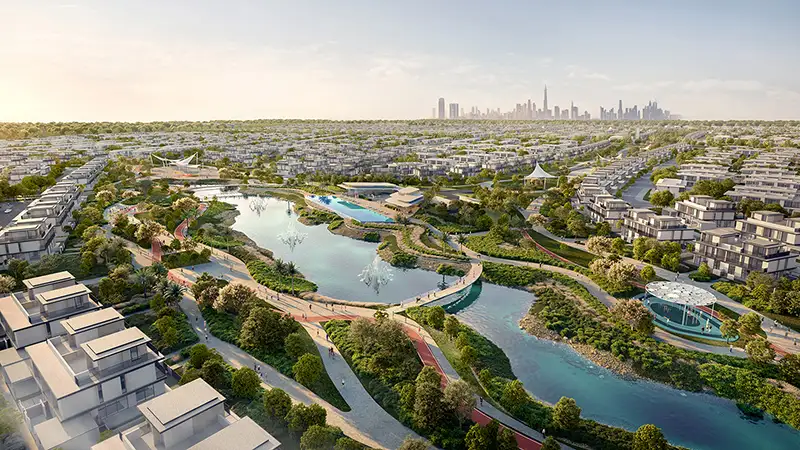

• DIP Shopping Malls — two shopping malls operate within the wider DIP community, covering everyday retail, dining, and services.
• Supermarkets — supermarkets are distributed across the community's residential sub-communities, including Green Community, Ritaj, and Dunes Village.
• Ibn Battuta Mall — one of Dubai's largest themed malls, approximately 17 minutes away, offering extensive dining, shopping, and a cinema.

• Community Hospitals and Clinics — hospitals and clinics operate within DIP's boundaries, covering day-to-day and specialist healthcare needs; residents consistently cite DIP's healthcare access as a genuine strength of the community.
• Nearby Hospitals — further private hospital and specialist facilities are available in neighbouring Al Furjan and Dubai South, a short drive away.

• Green Community Lakes and Gardens — landscaped gardens, lakes, and walking trails run throughout DIP's most upscale sub-community, giving it a genuinely serene, low-density feel.
• Swimming Pools — swimming pools are a standard shared amenity across the Green Community and several of DIP's other residential clusters.
• Ewan Residences Parkland — Ewan Residences in particular offers substantial parkland and landscaping, extending DIP's green space beyond the Green Community itself.
DIP’s defining character comes directly from its founding brief: a mixed-use development explicitly conceived to support Dubai’s economic diversification, bringing industrial, commercial, and residential zones together within a single, cohesive masterplan. That intent shows in daily life through genuine self-sufficiency, schools, hospitals, hotels, and malls all operating within the community, rather than requiring residents to commute elsewhere for essential services.
The Green Community stands apart as DIP’s most upscale and long-established address, gated, landscaped, and traffic-free, with a resident base that has grown steadily over more than a decade. Ritaj, Dunes Village, and DIP’s newer Third phase, by contrast, offer considerably more accessible pricing, drawing professionals and families connected to the surrounding industrial and logistics employers, and increasingly, airline crew, with a dedicated crew community groundbreaking scheduled for Q2 2026.
The resident profile reflects DIP’s dual industrial-residential identity: workers and business owners connected to the community’s more than 4,200 companies, families drawn by the Green Community’s schools and parks, and a growing base of investors targeting DIP’s genuinely strong yield performance. Residents consistently describe the area as calm, with easy access to lakes, healthcare, and reasonably priced housing, alongside a fair acknowledgement of heavier traffic during peak commuting hours.
Buyers should approach DIP’s ownership landscape with care: Green Community properties are predominantly leasehold, while other zones within the wider DIP corridor, including newer phases like DIP Third, offer full freehold title open to foreign buyers. Confirming tenure on any specific property before proceeding is essential, and DIP Third’s key differentiator from comparably priced communities like Discovery Gardens is its family-community character, including an on-site school, versus more purely apartment-block density elsewhere.
Lifestyle Highlights:
Dubai’s largest and most established free zone, approximately 10 minutes away, anchoring substantial logistics and industrial employment for DIP’s residential market.
The legacy site of Expo 2020, approximately 10 minutes away and directly connected via DIP’s own metro station, continuing to anchor development and investment across the wider corridor.
Dubai’s southern growth corridor and home to Al Maktoum International Airport, approximately 10 to 15 minutes away, a major current and future source of employment for DIP residents.
The established freehold villa and townhouse community approximately 10 to 15 minutes away, offering a comparison point for buyers weighing DIP against a more purely residential alternative.
The neighbouring apartment-dense community, often compared directly against DIP Third for buyers seeking affordable western-corridor housing with a more family-oriented alternative.
Nakheel’s low-density, single-row villa community within the wider Jebel Ali coastal corridor, offering a genuinely different, more spacious villa alternative to DIP’s mixed-use character.
Landmarks and Culture:
Nature and Outdoor:
Sport and Entertainment:
Shopping and Dining:
DIP is genuinely well regarded as a family community, with six schools operating within its boundaries, several offering the British curriculum, alongside the Green Community’s parks, lakes, and low-traffic streets.
Schools:
Family Amenities:
Higher Education:
What You’ll Find:
DIP’s property market spans a genuinely wide range across its seven sub-communities. DLD data shows apartment average sale prices around AED 1,134,493, with Ritaj averaging approximately AED 611,000 and DIP 2 apartments averaging around AED 601,769, considerably more accessible than the Green Community’s premium pricing. Villa prices averaged AED 2,170,000 in 2025, the sharpest per-square-foot growth of any Dubai community that year according to DLD’s annual report.
Rental pricing follows a similarly wide range: apartment rentals start around AED 3,500 per month for one-bedroom units and can reach AED 8,000 per month for three-bedroom family apartments in standard buildings, while Green Community two-bedroom units can reach AED 150,000 annually, roughly double the AED 70,000 to AED 80,000 typical of standard DIP buildings. Bayut’s 2025 data confirms apartment ROI of 9% to 10% community-wide, with three-bedroom units at approximately 8.5% and studios around 7.1%.
Market Insight:
DIP’s investment case rests on a genuinely rare combination for an affordable Dubai community: a captive, employment-anchored tenant base of more than 100,000 workers, its own dedicated metro station, and yield performance that Bayut’s confirmed 2025 data places among the strongest affordable returns in the city. DLD’s 2025 annual report placing DIP villas as the sharpest per-square-foot gainer of any Dubai community, alongside Green Community apartment appreciation of 41% since 2020, both point to a community whose fundamentals are increasingly reflected in hard transactional data rather than marketing projections alone. As Al Maktoum International Airport’s decade-long expansion continues and DIP Third adds further family-oriented, accessible supply, the wider corridor’s growth trajectory appears well supported.
Master Developer: Dubai Investments PJSC Established: 1997 Total Area: 2,300 hectares (approximately 47 square kilometres) Structure: DIP 1, DIP 2, and DIP Third; industrial, commercial, and residential zones Residential Sub-Communities: Green Community, The Palisades, Ritaj, Dunes Village, Dubai Lagoon, Ewan Residences, Staff Accommodation Companies / Workers: 4,200+ companies; 100,000+ workers Ownership: Mixed — predominantly leasehold in Green Community; freehold zones elsewhere in DIP Metro Access: Dubai Investment Park Station, Route 2020 Red Line extension Gross Rental Yields: 9%–10% (apartments, community-wide, per Bayut 2025 data) |
DIP asks buyers to value genuine self-sufficiency and employment-anchored demand over central-Dubai prestige: a community where schools, hospitals, hotels, and malls all sit within the same gates as the workforce that fills them, backed by confirmed metro access and some of Dubai’s strongest documented affordable yields. It rewards buyers who understand that a mixed-use, industrial-residential masterplan can also be a genuinely well-rounded place to live.
The case is straightforward. Apartment yields of 9% to 10%, confirmed by Bayut’s full-year 2025 data, among the strongest affordable returns anywhere in Dubai. DIP’s own confirmed metro station on the Route 2020 Red Line extension. A structural, captive tenant base of more than 100,000 workers connected to the community’s 4,200+ companies. And villa price growth that outpaced every other Dubai community on a per-square-foot basis in 2025.
At Vetra, we track DIP sub-community by sub-community. We know which buildings in Ritaj and Dunes Village deliver the strongest yields, how the Green Community’s leasehold structure compares to freehold options elsewhere in the corridor, and where DIP Third’s newer, family-oriented stock offers genuine value relative to established alternatives. Whether you are a yield-focused investor drawn to DIP’s confirmed strong returns, a family seeking the Green Community’s established, landscaped lifestyle, or a professional working within the wider Jebel Ali employment corridor, Vetra brings the expertise and honest guidance to help you make the right decision in Dubai Investments Park.
Contact Vetra’s experts for tailored guidance and listings.
Do you need a property valuation?
Contact Vetra today and let us help you navigate Dubai Investments Park with clarity and structure.